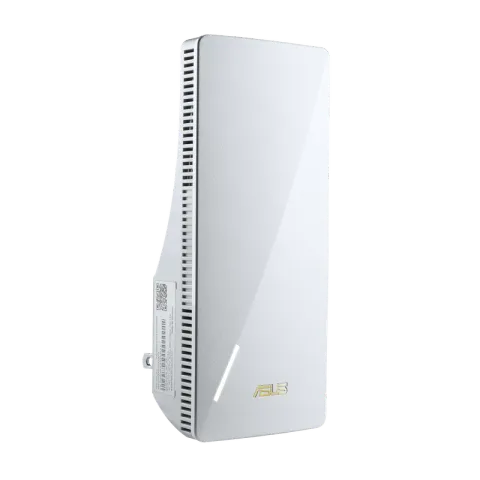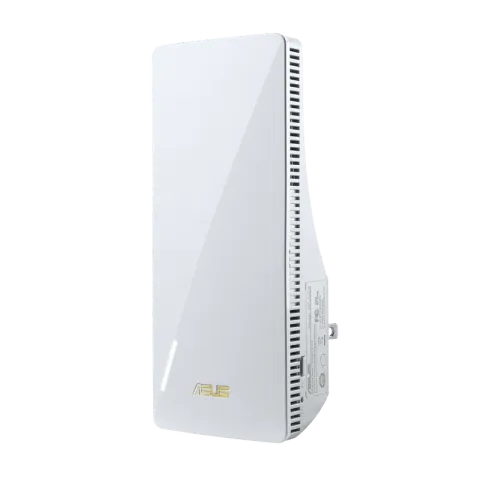

Two extenders made this list:
- ASUS RP-BE58 for most people. It has Wi-Fi 7 on 2.4 and 5 GHz, an Ethernet port, and it can join an ASUS mesh network.
- ASUS RP-AX58 if your router and devices are Wi-Fi 6 or older and Wi-Fi 7 features wouldn’t help you.
We haven’t tested these extenders ourselves. We picked them from ASUS’s specifications against the criteria below. Both come from a manufacturer whose repeaters hold a current FCC Conditional Approval.
Is an extender the right fix?
Before you buy anything, rule out the free fixes. A router tucked in a cabinet or at one end of the house can leave rooms weak that would be fine with better router placement. How to fix Wi-Fi dead zones walks through the other causes, from building materials to interference. If you’re on gFiber and use its router, check gFiber’s own extender first.
Where to put it
Placement matters more than the model. ASUS advises putting an extender halfway between the router and the place where you use your devices most. An elevated, open spot works best, away from walls and metal that block or reflect the signal.
The halfway rule exists because an extender passes on everything it receives from the router. Put it inside the dead zone and its own link back to the router is weak, so every device connected to it is slow too.
The criteria that decide it
- A wired option. If you can run an Ethernet cable from the router to the extender, use it. ASUS says a wired connection to the RP-BE58 leaves its entire 2.4 and 5 GHz bands free for your devices. Both picks have a Gigabit Ethernet port for this. See mesh backhaul explained for why it helps.
- Mesh-node support. Both picks can join an ASUS AiMesh network as a node, so with an ASUS router they act like part of a mesh system rather than a separate network.
- A Wi-Fi generation your devices use. Wi-Fi 7 features such as Multi-Link Operation only help Wi-Fi 7 devices. If everything in the weak room is Wi-Fi 6 or older, the RP-AX58 covers what you’ll actually use. Wi-Fi 7 explained covers what’s new.
- Verifiable US regulatory status. As of the FCC’s notice of 9 September 2026, ASUS repeaters held an FCC Conditional Approval running to 6 March 2028. See the FCC router rule explained.
How the two compare
ASUS lists the RP-BE58 as a BE3600 Wi-Fi 7 extender, rated up to 688 Mbps on 2.4 GHz and 2,882 Mbps on 5 GHz, with two streams on each band and one Gigabit Ethernet port. ASUS claims it extends coverage by up to 2,200 sq ft and supports Multi-Link Operation. That coverage figure is ASUS’s claim under its own conditions, not a measurement of your home.
The RP-AX58 is the Wi-Fi 6 equivalent: AX3000, rated up to 574 Mbps on 2.4 GHz and 2,402 Mbps on 5 GHz, with two streams on each band and the same single Gigabit port. ASUS doesn’t publish a coverage figure for it.
Neither has a 6 GHz radio. If you want 6 GHz in the weak area, look at a tri-band mesh system or access point instead.
Why this list is short
We only include extenders whose specifications we could confirm on the manufacturer’s own pages and whose US regulatory status we could match to a dated FCC notice. ASUS is the only extender maker named in the FCC’s September 2026 approvals notice, and these are its two current extenders. Prices aren’t listed because they change constantly. Each “Check price on Amazon” button opens an Amazon search for that exact model.