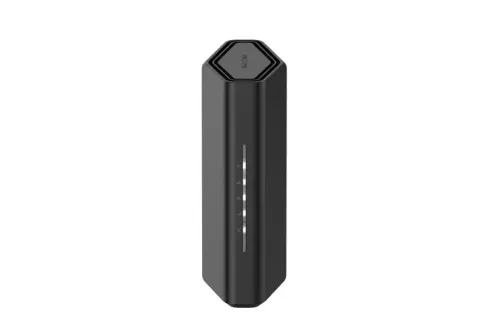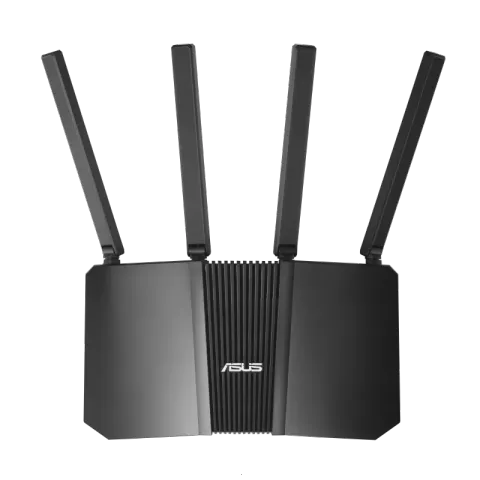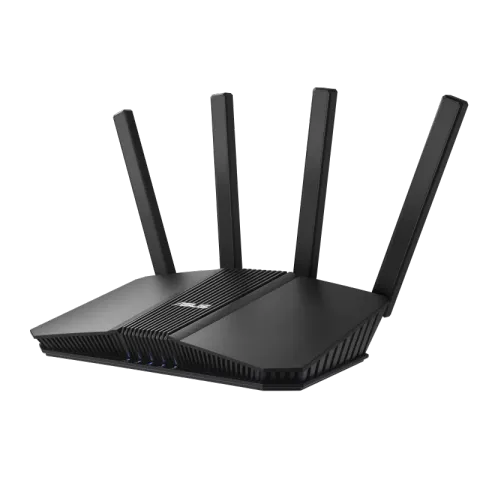
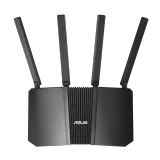
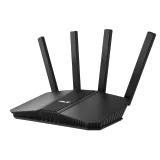
Three entry-tier routers made this list:
- NETGEAR Nighthawk RS100 if you’d like an app-guided setup and four gigabit ports.
- ASUS RT-BE55 if you want parental controls without a subscription.
- ASUS RT-BE59 if you have more devices, or one wired device that can use 2.5 Gbps.
We haven’t tested these routers ourselves. They were chosen from the manufacturers’ specifications against the criteria below, and each one’s US regulatory status was checked against the FCC’s most recent approvals.
What “budget” means here
We don’t define budget by a price, because router prices change too often for a fixed cut-off to stay true. Instead, this list covers the entry tier: routers with
- dual-band Wi-Fi 7 (2.4 and 5 GHz, rated BE3600 to BE5000),
- a 2.5 Gbps internet port, so a plan faster than 1 Gig isn’t capped at the wall,
- mostly gigabit wired ports, and
- manufacturer coverage claims sized for small and medium homes.
That’s the simplest tier we’d still buy today. What you give up compared with the best Wi-Fi routers is the 6 GHz band, a third radio and multi-gig wired ports. If you have Wi-Fi 6E or Wi-Fi 7 phones and laptops, or a plan faster than about 2 Gig, step up to that list or the best routers for multi-gig internet.
The criteria that decide it
- A 2.5 Gbps internet port. All three picks have one, which leaves headroom for gigabit plans and lets a plan up to about 2 Gig through.
- The 5 GHz radio. BE3600 routers have a two-stream 5 GHz radio; BE5000 routers such as the RT-BE59 have a faster three-stream one. Router speed ratings explained shows what those numbers add up to.
- Wired ports. Most budget routers have gigabit LAN ports only. The RT-BE59 adds one 2.5 Gbps LAN port for a desktop or NAS.
- Subscriptions. NETGEAR includes a trial of its optional Armor security subscription; ASUS says the parental controls on its two picks work without a subscription.
- Verifiable US regulatory status. NETGEAR’s Nighthawk RS series and ASUS’s RT series hold FCC Conditional Approvals, until 1 October 2027 and 6 March 2028 respectively, as of the FCC’s notice of 9 September 2026. The FCC router rule explained covers what that means.
The picks at a glance
| Pick | Wi-Fi | Internet port | LAN ports | Coverage claim |
|---|---|---|---|---|
| NETGEAR RS100 | BE3600, 2.4 + 5 GHz | 2.5 Gbps | 4 × 1 Gbps | Up to 2,000 sq ft |
| ASUS RT-BE55 | BE3600 (688 + 2,882 Mbps) | 2.5 Gbps | 4 × 1 Gbps | Up to 2,000 sq ft |
| ASUS RT-BE59 | BE5000 (688 + 4,320 Mbps) | 2.5 Gbps | 1 × 2.5 Gbps, 3 × 1 Gbps | Up to 2,300 sq ft |
NETGEAR rates the RS100 for up to 2,000 sq ft and 50 connected devices; ASUS rates the RT-BE55 for up to 2,000 sq ft and the RT-BE59 for up to 2,300 sq ft. Coverage figures are each manufacturer’s claim, not a measurement of your home.
What we left out, and why
We only include routers whose specifications we could confirm on the manufacturer’s own pages and whose US regulatory status we could match to a dated FCC notice. NETGEAR’s BE5000 RS150 is a reasonable alternative on paper, but we couldn’t find an official photo of that exact model, so it’s left out for now. Travel routers and gaming-branded models are outside this tier. Prices aren’t listed because they change constantly; each “Check price on Amazon” button opens an Amazon search for that exact model.